Loons on Groton Pond
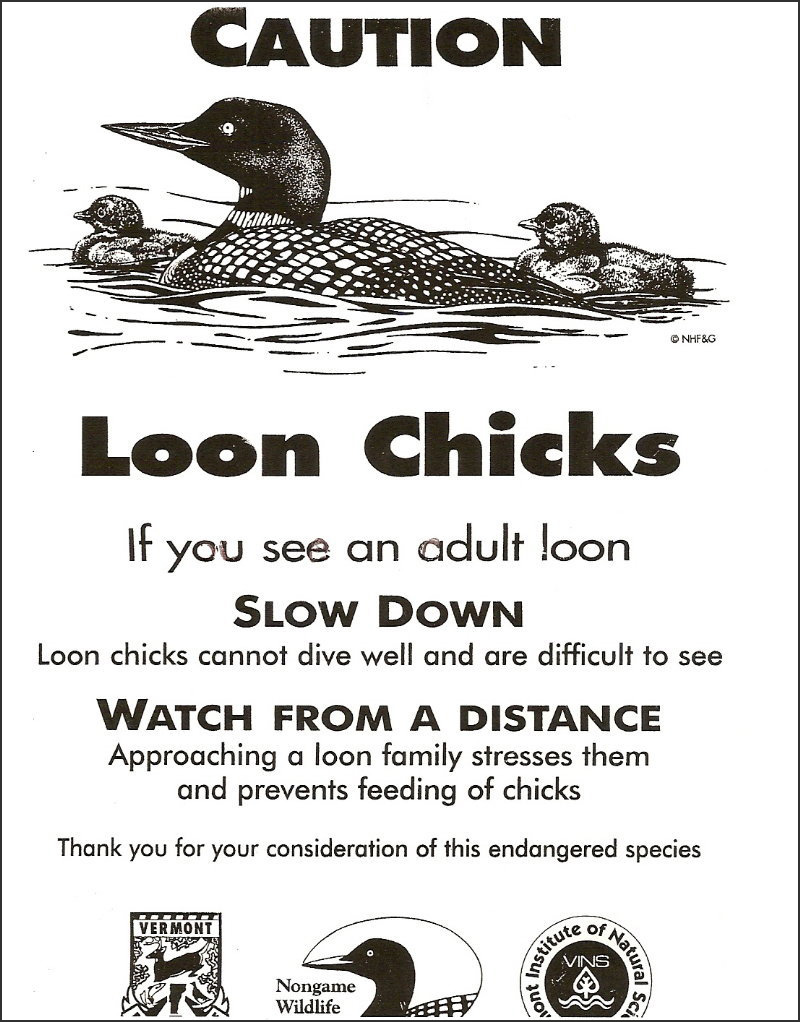
Watching and hearing loons has provided enjoyment to generations of Lake Groton residents. Lake Groton is above average in nesting success. Loon chicks’ survival is greatly dependent on our vigilance during boating and fishing season. They also have predators from above and below . Newborn chicks are the size of your fist and very hard to spot. Some things that humans can do to help loons thrive are to avoid using lead sinkers, don’t leave your fishing line in the water, and don’t get too close or go by too fast when boating. May – July is the breeding and nesting season on the lake. Chicks remain vulnerable through the rest of the summer. Please keep your distance while watching loons with or without chicks. During this period the nesting areas are marked off at with white signs. Please help the chicks survive by staying away from their nesting area, and at least 20 yards away from them in the water.
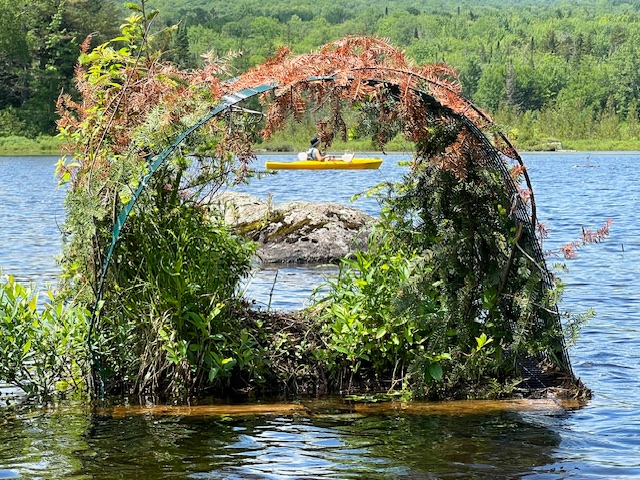
Loons on Lake Groton nest more successfully on nesting platforms than they do on the shore. The south end of Groton had a nesting platform from 2000 to 2012 and during these years there were only 2 years without success. From 2013 – 2022 there was no raft and there were only 2 successful nestings. In 2023 a new nesting platform was placed and there has been successful nesting thereafter.
The north raft was put in in 2012 and successfully used until 2023. During this time the nest was successful about 3/4 of the time. In 2024 the raft was abandoned after the second year of flooding. In 2025 the nesting raft was moved to a different area on the north shore, and the loons successfully nested.
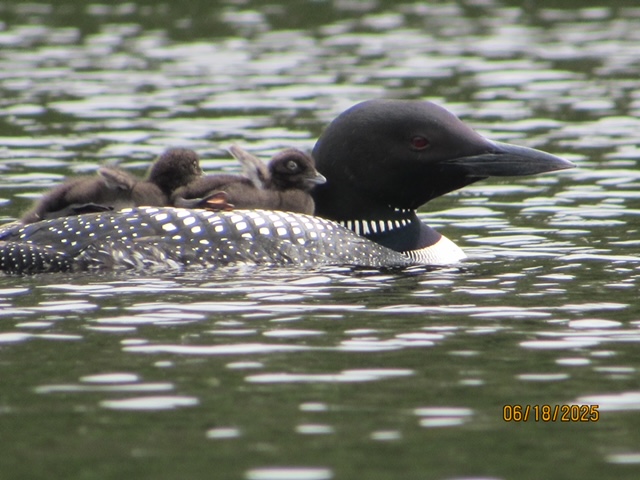
The south end pair had 2 chicks born around 6/16/25, but unfortunately only one chick has survived. The north pair had two chicks on 7/2/25 and both chicks are thriving.
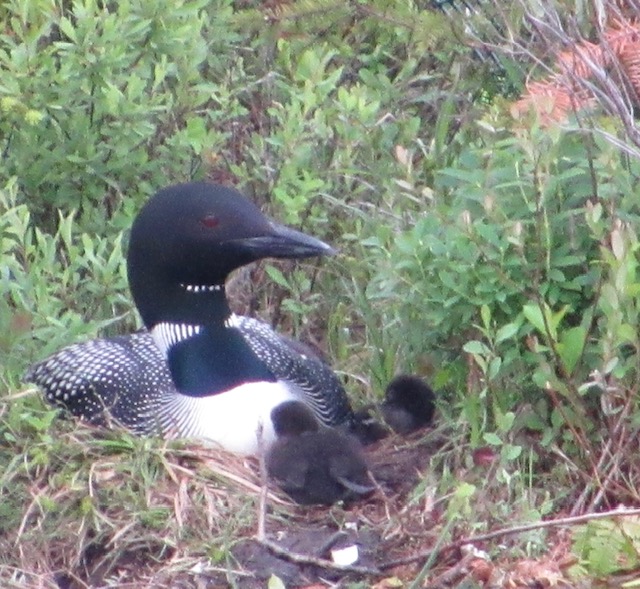
Loons have an incubation period of about 28 days. One parent is always on the nest keeping the eggs warm and turning them. This duty is shared by both parents. Loons usually have one to two eggs. Once the babies are born, the loons leave the nest. Loons sleep on open water to protect themselves from land based predators. The babies stay with their parents, on their backs or under their wings in their early days. This keeps the chicks safe from fish and turtle predators. The babies are fed by their parents for about six weeks. Baby loons can dive after about a week.
Most birds have hollow bones, but loons have solid bones, which makes them unwieldy on land. Adult loons can be up to 28 inches long. They generally have a 50” wingspan. Adult loons weigh 8 to 12 pounds. The males are slightly heavier than the females but otherwise look no different. This extra weight helps the loons dive as deep as 250 feet. They can stay underwater for about 5 minutes. It takes about 3 to 4 months before a baby loon can fly. Loons can fly more than 75 mph. Loons can live 30 years or more.
At the end of the summer, male loons leave first, then the females. The adult loons fly to different coastal areas separately. They reunite in the spring in their nesting area. Loons are committed pairs. The juvenile loons also migrate. The juveniles remain for several years on the coast until they are ready to return to the lake environment for breeding.
Lake Groton is fortunate to have 2 volunteer loon monitors, Gail McDonnell and Barb Zander. Gail primarily monitors loon activity on the south end and Barb monitors loon activity on the north end.
If you see any activity that you suspect is the harmful to the loons or have any questions about their behavior please contact Gail at 860-874-3051 (Memorial Day through Labor Day) or Barb at 802-751-9063. Other contact is loon biologist Eric Hanson at 802-586-8064 or loon@vtecostudies.org
We are grateful to loon volunteer Darlene Sprague for monitoring the loon population from 1997 – 2024.
I
“Calls in the Wilderness” a poem by Darlene Sprague
Diary of a Volunteer (An article by Darlene Sprague from the Vermont Loon Caller)